Buenos Aires Circle #2 – From Ideas to Winnable Issues
Date: May 21st - 2026
Location: Crecimiento, Buenos Aires, Argentina
Luma: Logos Circle BA #2 · Luma
Registered on Luma: 44
Attendance: 10 participants
Languages: Spanish, Italian, English
Overview
Following the inaugural Buenos Aires Circle, our second gathering shifted from an open discussion format to an interactive workshop. The objective was to move from broad conversations about Network States and decentralized governance toward identifying concrete local challenges that could become winnable issues for future collaboration.
The workshop encouraged every participant to actively contribute ideas, identify shared motivations, and collectively prioritize areas where decentralized technologies could have meaningful real-world impact.
Workshop Format
The session was structured in three phases:
1. Individual Reflection
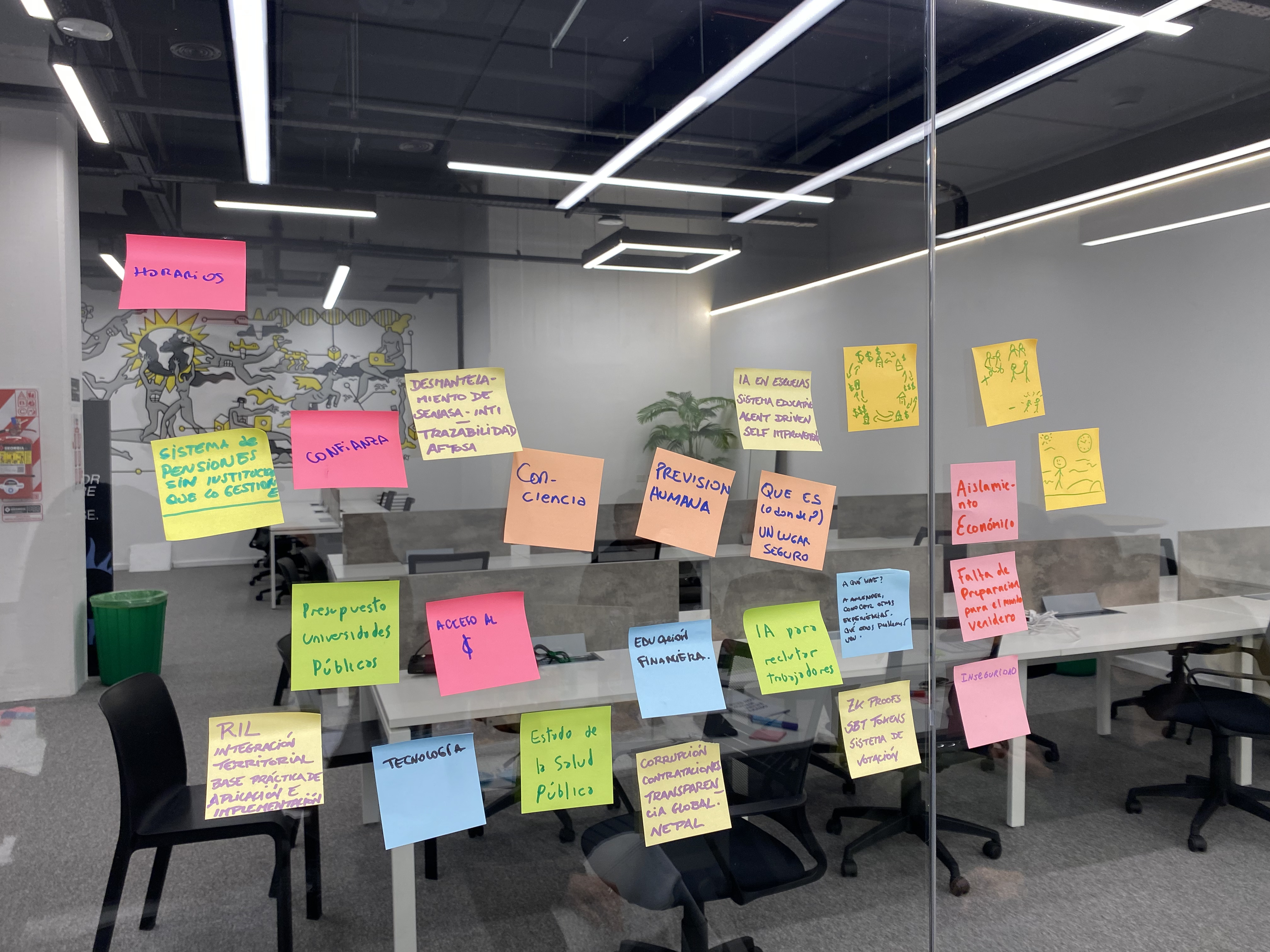
Participants began by writing on Post-it notes the issues, opportunities, or motivations that had brought them to the Circle. Rather than focusing on technical solutions they were encouraged to think first about the problems worth solving.
2. Collective Clustering
The group then organized similar ideas into thematic clusters, allowing common interests to emerge organically. This exercise revealed significant overlap between participants despite their diverse professional backgrounds.
3. Winnable Issues Discussion
Finally, each cluster became the starting point for a conversation around which challenges could realistically become collaborative projects within the Buenos Aires community.
The visual mapping exercise helped transform dozens of individual ideas into a smaller number of shared priorities.
Participants
The Circle once again attracted an interdisciplinary group including entrepreneurs, developers, lawyers, researchers, governance enthusiasts and community builders.
Doko, Ernesto and Michele came back and we welcomed Josefina, Chango, Sergio, Santino, Lucas and Thomas (who will be participating at the Brussels circle).
Some notable perspectives included:
-
Chango (Netxgen) presented his vision for regenerative nodes: a three-layer infrastructure combining physical, legal, and digital systems. Inspired by the work of Jacque Fresco and Roxanne Meadows, he described Netxgen as an ecosystem for regenerative communities.
-
Doko shared lessons from governance initiatives in Nepal, emphasizing the importance of transparent public infrastructure and discussing how decentralized tools could strengthen government accountability. Examples included the weakening of institutions such as SENASA and the importance of territorial governance through RIL or any other other NGO.
-
Participants also included professionals working in legal contracts, education, computing, AI, governance, finance, and public policy bringing multiple perspectives into the workshop.
Emerging Themes
As participants grouped their ideas together several recurring themes emerged:
-
Governance and institutional transparency
-
Public health and healthcare systems
-
Financial education and access to capital
-
Regenerative finance
-
Territorial governance
-
Scientific development
-
Economic resilience
-
Artificial Intelligence and the future of work
-
Public universities and education
-
Trust and institutional legitimacy
-
Security and community resilience
-
Digital infrastructure for public services
Rather than arriving with predefined topics, these priorities emerged organically through the collective exercise.
Potential Winnable Issues
Several promising directions for future exploration were identified:
-
Transparent governance tools for public institutions.
-
Blockchain applications for public procurement and institutional accountability.
-
Regenerative economic models connecting physical, legal, and digital infrastructure.
-
Improving financial literacy through decentralized technologies.
-
Digital identity and governance systems.
-
Local experimentation around territorial governance models.
-
AI applications that empower individuals rather than replace them.
Key Insights
The workshop generated several important observations:
-
Participants naturally gravitated toward solving societal coordination problems rather than discussing cryptocurrencies themselves.
-
Interactive facilitation produced significantly broader participation than a traditional discussion format.
-
Many seemingly different concerns converged around common themes such as trust, governance, education and transparency.
-
Visual mapping helped participants recognize connections between ideas that initially appeared unrelated.
Outcomes
-
The workshop successfully transformed individual motivations into a shared map of community priorities.
-
Several participants expressed interest in collaborating beyond the event around specific themes.
-
The exercise produced an initial backlog of potential “winnable issues” that will guide future Buenos Aires Circle programming.
-
The participatory methodology proved highly effective and will continue to inform future Circle formats.
Lessons Learned
Moving from discussion to facilitation significantly changed the dynamics of the Circle. Rather than relying on a few dominant voices every participant contributed ideas that ultimately shaped the collective agenda.
One of the most valuable lessons was that asking “What problems are worth solving?” generated richer conversations than beginning with technology. By focusing first on shared challenges, participants naturally explored how decentralized systems, governance innovations and community coordination could become practical tools rather than abstract concepts.
An important insight was that many participants see value in contributing to the broader Logos ecosystem rather than creating isolated local initiatives. For the June Circle, I’ll prepare an overview of the projects and experiments underway across other Circles, enabling the Buenos Aires community to connect with existing efforts and collaborate globally.
Looking Ahead
The second Buenos Aires Circle marked an important evolution for the local community. Instead of simply exchanging ideas, participants collectively identified areas where they believe meaningful experimentation can take place. These shared priorities will serve as the foundation for future Circles, allowing the community to progressively move from conversation to collaboration and, ultimately, to real-world implementation.