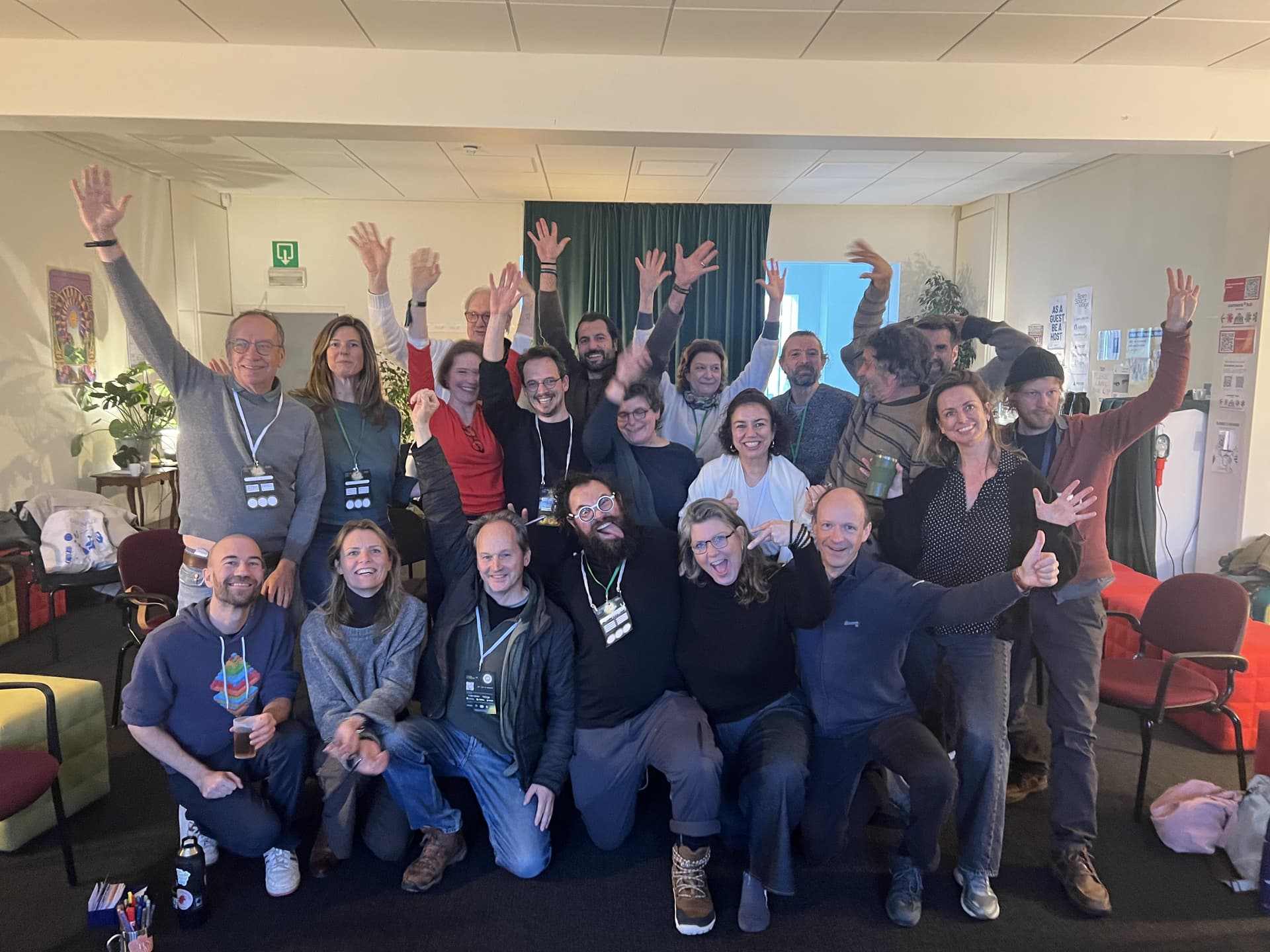
This was a blitz circle in the context of the Open Source Village following FOSDEM in Brussels, where activists and open source developers from all over the world converge. Next to this there was also a day on ‘community building irl’ as part of the Village which I attended, more on this at the end.
Note: I’ve hidden some parts for readability, click these open for more details!
Stats on the event
Date: 02/03/2026
Location: Commons Hub, Brussels
Registered on Luma: 24
Attended: 16
Languages: English spoken, native languages: English; French, Dutch, Portuguese
Circle Steward: Kris (ad interim)
TLDR
There was quite some skepticism about Logos’ ability to achieve adoption and scale. Key concerns centered on whether a non-EVM sovereign chain can compete with Ethereum’s network effects, whether privacy and interoperability can be delivered at scale, and whether strong values can compensate for the lack of a clearly proven product, tech stack, governance, and volunteer incentives.
While Logos is seen as well aligned with the Commons Hub Brussels, its value proposition and scalability came across as too broad. Outreach efforts converted poorly despite broad promotion, signaling a need for starting earlier, more paid growth & growth hacking. Interest exists, including abroad, but no one currently has capacity to lead a local circle. Core operational tooling and materials could benefit from simplification.
Participants
Summary
- 16 attendees, 5+ countries (Belgium, US, Brazil, UK, Germany, Italy)
- Backgrounds: blockchain, software development, open-source governance, ReFi, commons, and newcomers curious about crypto.
- Areas of interest or focus: how this can benefit existing volunteering work, focus on Logos’ motivations, ethical implications and value proposition.
Event Structure
Summary
- 730pm-930pm
- Agenda
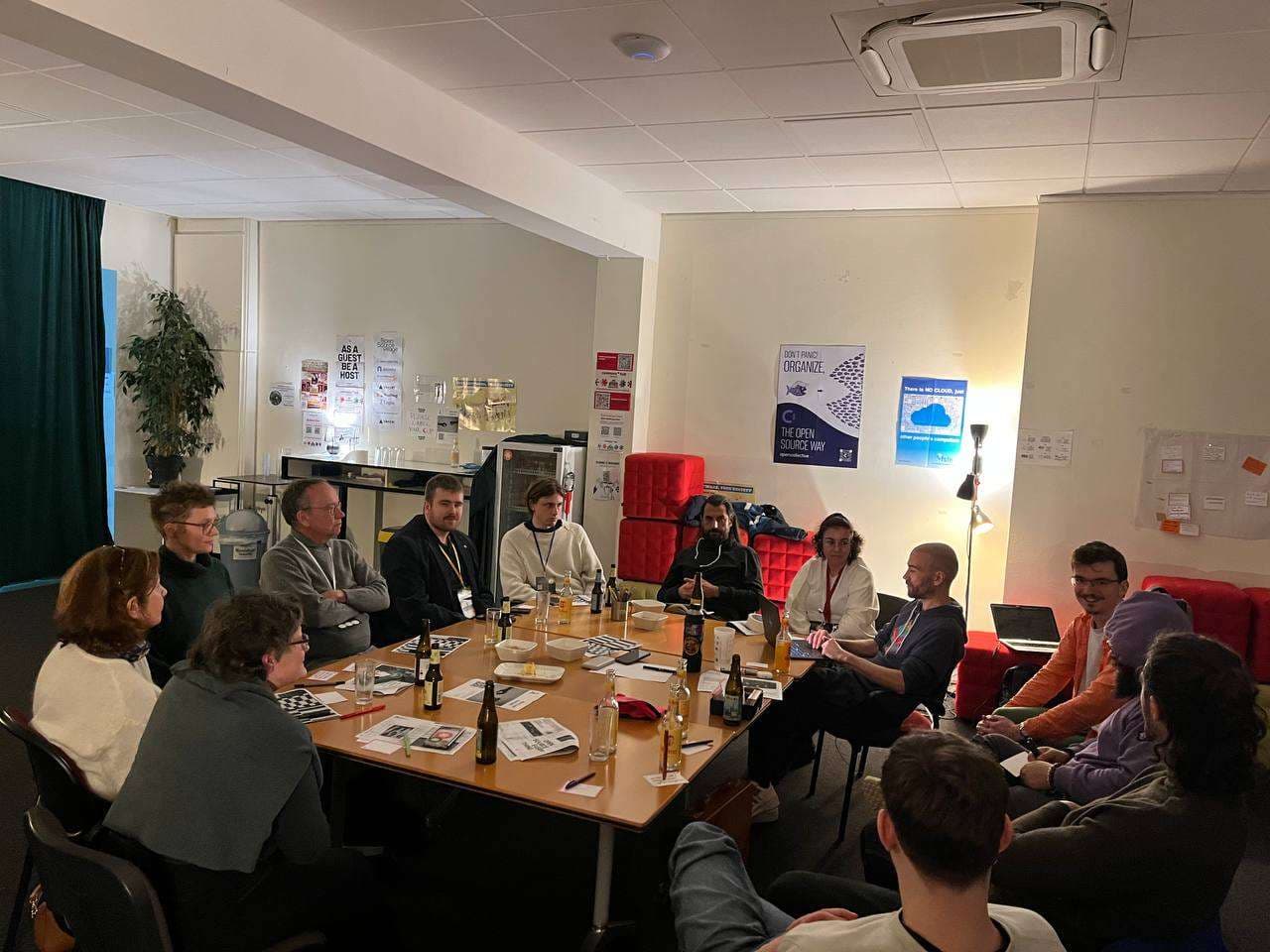
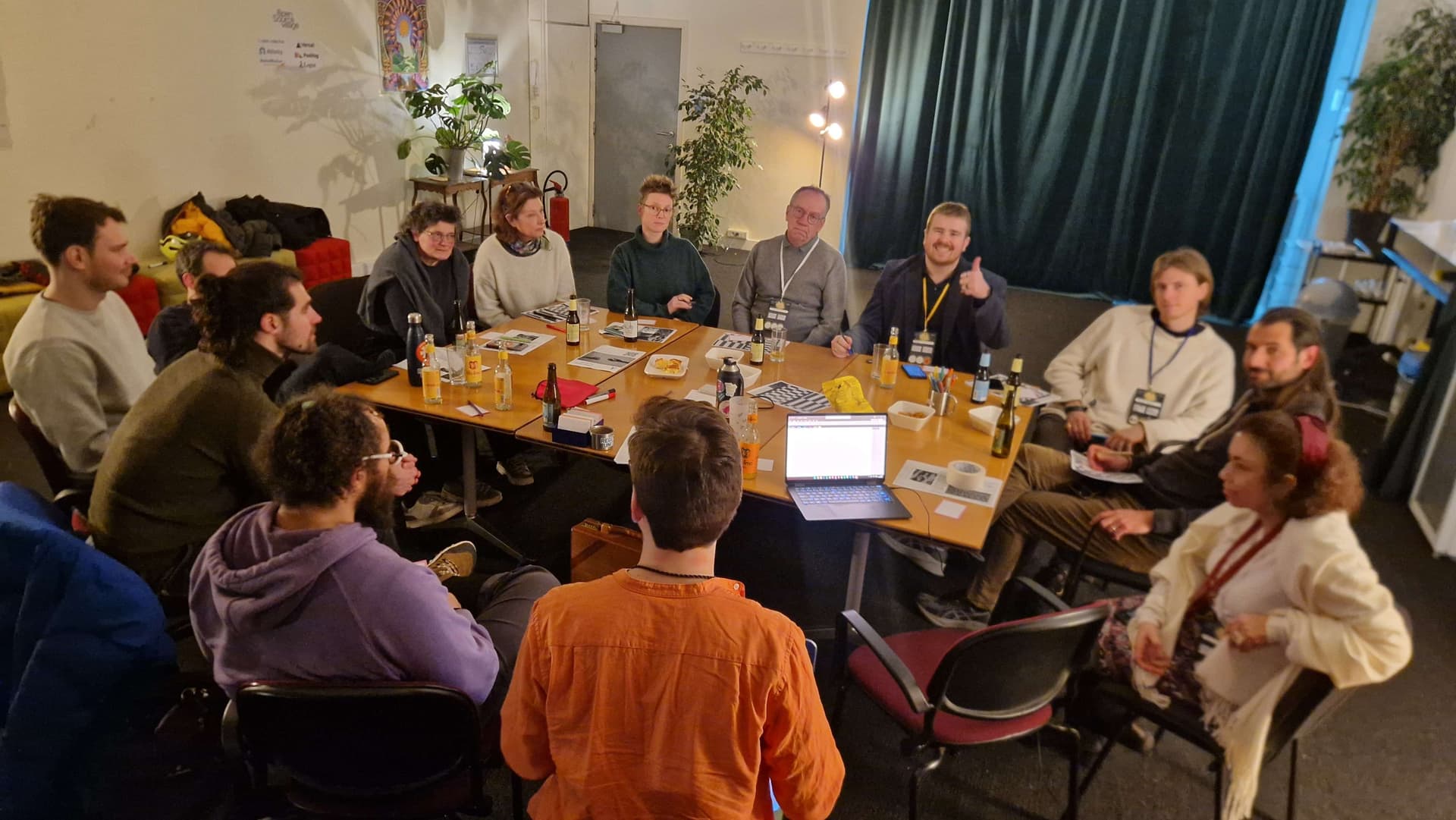
- Welcome drinks & snacks
- Personal intros & stories
- Intro to Logos
- Focus on local issues, identifying winnable issues
- Farewell & next steps
Note: All participants were okay with images shared as is
Topics Discussed
Personal intros & Stories
Summary
- Motivations to show up ranged from belief in rebuilding community and collective power, to simple curiosity, peer support, or interest in open source, activism, and alternative economic systems. A recurring challenge is uncertainty: many participants feel disconnected from or confused by crypto and blockchain, question its real-world value, worry about volatility, privacy, surveillance, and environmental impact, or struggle to see how the tech meaningfully connects to social change rather than hype.
- Alongside that skepticism, there was a shared proposal-in-the-making: use decentralised tools to support community, coordination, and experimentation in the real world. People point to linking existing initiatives, commons-based organising, regenerative finance, and open source culture as promising directions. Technologies and tools mentioned during the intros include blockchain in general, Bitcoin and Ethereum, wallets like MetaMask, NFTs, AI, open source software, and Web3 infrastructure, framed less as ends in themselves and more as potential building blocks for collective action and systemic change.
Intro to Logos
-
Challenges or open questions (!)
- Whether building a non-EVM, fully sovereign blockchain can realistically achieve adoption given Ethereum’s network effects.
- How Logos will technically deliver strong privacy, interoperability, and censorship resistance at scale, strong doubts on how this can scale given the difficulty of interop and relatively small team
- Long-term trust and credibility hinge on clearer explanations of the tech stack, governance, and incentives for volunteers to participate.
- Risk that strong narrative and values are not enough without a demonstrably robust product.
-
Solutions, ideas, or proposals: Kris dug into strategy Circles Handbook
Summary
- We want to build communities first around shared values, rituals, mutual aid, and collective action, not around speculation.
- Use small, autonomous circles with distributed leadership and no central authority.
- Focus on “winnable issues” at a local, concrete scale to create real outcomes and momentum.
- Develop tools for accountability, role assignment, and leadership development inside circles.
- Accept that Logos is early and experimental, and treat it as a long-term infrastructure project rather than a quick play.
- Emphasize sovereignty and privacy as core design principles, even if that means building a custom stack.
- Technologies or tools mentioned
Summary
- Logos blockchain, still under development, with testnet upcoming.
- Status messaging app, live since 2017, used as a reference point for the ecosystem.
- Censorship-resistant messaging and private, peer-shared document storage.
- Non-EVM, custom blockchain stack focused on governance and privacy.
- Snowflake model for organizing grassroots movements and distributed leadership.
- Concepts like interoperability layers, governance rulesets, and privacy-first infrastructure.
- Action Items or Next Steps (!)
-
Kris to get feedback on EVM compatibility, received through Amelia.
"It seems the blockchain can do EVM-equivalent execution (indirectly) through its Sovereign Zones. EVM zones process transactions and push data to the blockchain. So not directly on the base layer.”
-
Feedback after check in with technical attendee:
At this stage it’s way too complicated. Don’t want to invest time to learn yet another way of doing things. But maybe with agents this is a moot argument. At the end of the day, it’s a matter of having a killer app and recipes that people can easily ask their openclaw agent to make use of.
-
Focus on local issues, identifying winnable issues
-
Key Points & Insights
- Many doubts when expressing certain ideas if Logos can actually provide any added value
- Consensus that there are so many initiatives we should reinforce rather than start new ones that will not survive because of lack of financial support or volunteer bandwidth
- Strongest proposals were expanding the ‘clean the park initiative’ that is linked to tokens which exists in the commons hub, a mesh network for Brussels and reinforcing the existing token initiatives.
- Technologies or tools mentioned: Citizen Wallet, Brussels Pay, FreiFunk Berlin, Zinne Token, …
-
1. Digital Tools and Coordination
Summary
- Neighborhood noise alert app
- Privacy-preserving by design with a push signal to a limited geographic radius
- Pre-escalation workflow to resolve issues before involving authorities
- Optional discussion layer for local dialogue - Community idea aggregation and voting
- Collection of local proposals
- Surfacing shared priorities
- Lightweight, transparent decision-making - Open-data accountability for government officials
- Automated public data requests from politicians
- Deadline and response tracking with public-facing dashboards
- Example: delays in cigarette-butt enforcement data in Brussels, we see no one is following up on this although they ‘promise’ - Youth civic coordination channel
- Digital platform (e.g. Discord) with gamification to encourage participation
- Focus on coordination and civic engagement (//Nepal)
- Challenge: what is the winnable issue here? Feedback: we unite the people to be able to take swift action - Resilient local communication infrastructure
- Mesh Wi-Fi for Brussels so we can set up decentralized communication during outages
- Referenced examples from Berlin (existing) and Iran (needed)
- 2. Social and Urban Initiatives
Summary
- Litter reduction
- Currently already exists as an initiative at the Commons Hub, tokens can be earned by cleaning the park
- We could expand this initiative - Local currency Zinne
- Tech expertise is missing here, it should be connect to initiatives such as Brussels Pay and Citizen Wallet, both coming out of the Commons hub
- Consensus that we should focus on amplifying existing initiatives - Anger release circles
- Anonymous or semi-anonymous participation
- Tinder for angry people: clear rules to vent and listen and then part ways again
- Strict safety and consent protocols - Employment mentorship programs
- Inspired by ‘Duo for a Job’, an existing program in Brussels: job mentoring meetups
- Focus on language barriers, many people come here and don’t speak the language, they need extra support that goes beyond Dutch & French
- Designed to complement rather than replace Brussels Govt program - Small-scale urban interventions
- More playable streets, called Superblocks, organizing infra needed, exists as https://playstreets.brussels/, crucial to reconnect citizens and bring them together
- Vertical gardens and shading walls, occupy parking spaces with mobile gardens - Food waste reduction
- Community collection initiatives, incl organizing local composting
- Coordination with existing Brussels-based efforts (a lot exists)
Other Highlights
- Food & logistics: we just offered some snacks & drinks. Together with the room these all were part of the 1K sponsor agreement we had with the opensource village.
Outcomes
- Consensus that Logos seems very value aligned with the Commons Hub.
- Many question how Logos can scale this initiative given the wide and broad range of winnable issues that can get accepted - the value proposition of Logos needs to be clearer.
- Visitors from outside Brussels were intrigued, at least one is considering starting up a local circle (Liminal Village, Italy).
- All attendees expressed they did not have the bandwidth to take a leading role in a future Brussels Circle but would love to stay in the loop.
Learnings
Things that worked well
- The zine was definitely a success and thoroughly perused by attendees.
Areas for improvement
- Reach:
- Next to an X post by Commons Hub (retweeted by Logos) plus boosted (paid) and a LinkedIn post by the Hub and myself I shared in all blockchain related groups in Brussels plus all Brussels related groups. Also on Linkedin, X, Bluesky and Nostr. We were also featured on Luma’s ‘What’s Happening in Brussels’. I also created posters which were distributed all over the hub.
- Despite all this only 6 people registered who were not related to the Commons Hub one way or other and… all these people were no-shows.
- We need to invest more in paid advertising plus do more growth hacking for the main Logos account imo. Next to this it would be good to have posters available for all circles plus share more best practices across Circles of what worked in other countries to increase reach.
- Next to this I think a new Circle should be announced at least a month before kickoff, so there’s enough time to attract the right profiles.
- Wiki
- Strong need to reorder the Circles Wiki and to add links in all the places. While explaining you really need to be all over this guide.
- I already added a few under ‘the first circle’.
- To facilitate a step-by-step for stewards a rework would align with the task lists we want to create for stewards on the upcoming Steward Dashboard. I’d recommend splitting up the wiki in one part for Stewards and one for general info. Happy to work on this.
- Zine update
- It took me way too long to figure out and print the Zine.
 Can we put this in an easy to print format and also adapt this to be folded to A5 format?
 - One zine is in jpgs, other is in pdfs. Pretty sure most people don’t have a paying subscription to Adobe (I don’t) so maybe we can research an easy tool in which we upload these files to be printed from?
- Jpgs are layed out to be printed as A4, did this and stapled together. Pages should be layed out differently if we want to print it to A5, as it’s meant to be
- Which zine do we recommend people to print out?
- It took me way too long to figure out and print the Zine.
New ideas or experiments to try next time
- Separate wiki sections (see above)
- Consider a separate track/program to join forces with existing communities all over the world.
- We could on the one hand team up with current initiatives that are coming into existence, such as Hubs Network
- We could start inventorizing what exists out there (CiviCrm + wiki) and help build communication rails
- We could build out a network of community builders and facilitators across the planet (CiviCrm + wiki), more on this below (’Building IRL’)
- I would recommend to use slides for the intro to Logos, they exist. Keeping people’s attention for 20 minutes without any visual aids is not so easy, makes things too abstract, people zone out.
- I would not ask people if they know about crypto but if they know about blockchain. I recommend to update wording
- SWAG
- Would be great to have some updated stickers and swag and also add recommendations for easy printing, maybe we could just send these to stewards from hubs on the various continents? For swag web3privacy definitely beats us at this game.
- A fun gadget to send to Stewards could be an AI note taking device, one contributor brought a Plaud, which we used.
Extra thoughts on Building in IRL
Logos sponsored the Open Source Village and in this context I also attended the ‘Building IRL communities’ event where I co-hosted one session on incentivization, roles and accountability.
Some key things that stood out for me:
- There is a network of community facilitators out there that is craving more network weaving - staying in touch and easily sharing knowledge continues to be the biggest hurdle across facilitators & builders. They are also very, very eager to help build parallel societies. I think there’s a lot of untapped potential here.
- In the AIDA funnel at some point volunteers will move from ‘I’ to the ‘We’. In the end it’s about creating a lasting sense of identity and belonging. The ‘I’ to ‘We’ funnel resonated a lot.
- A lot of knowledge was shared, on motivation, ao Joris Piot’s ‘Eat Love Volunteer’.
Piot’s TRS model (Task–Relation–Structure) focuses on building meaningful social relations and shaping organizational structures that support autonomy and engagement rather than rigid control. He also emphasizes focusing on the life phase of the group (e.g., dynamism, stability, or stagnation). - Other sources mentioned were ao Peter Block, Sociocracy 3.0, and Frederic Laloux’s Reinventing Organizations, and how we can move our society again from the egocentric to the sociocentric.
- My thoughts are that we should urgently work on seeing how we can turn Logos itself in a more sociocratic and/or Teal organization (where needed). One easy place to start is the 7 principles of Sociocracy. I think this should be core to our DNA, and I think to some extent they already are.