(Full report is also available as a Google Doc here)
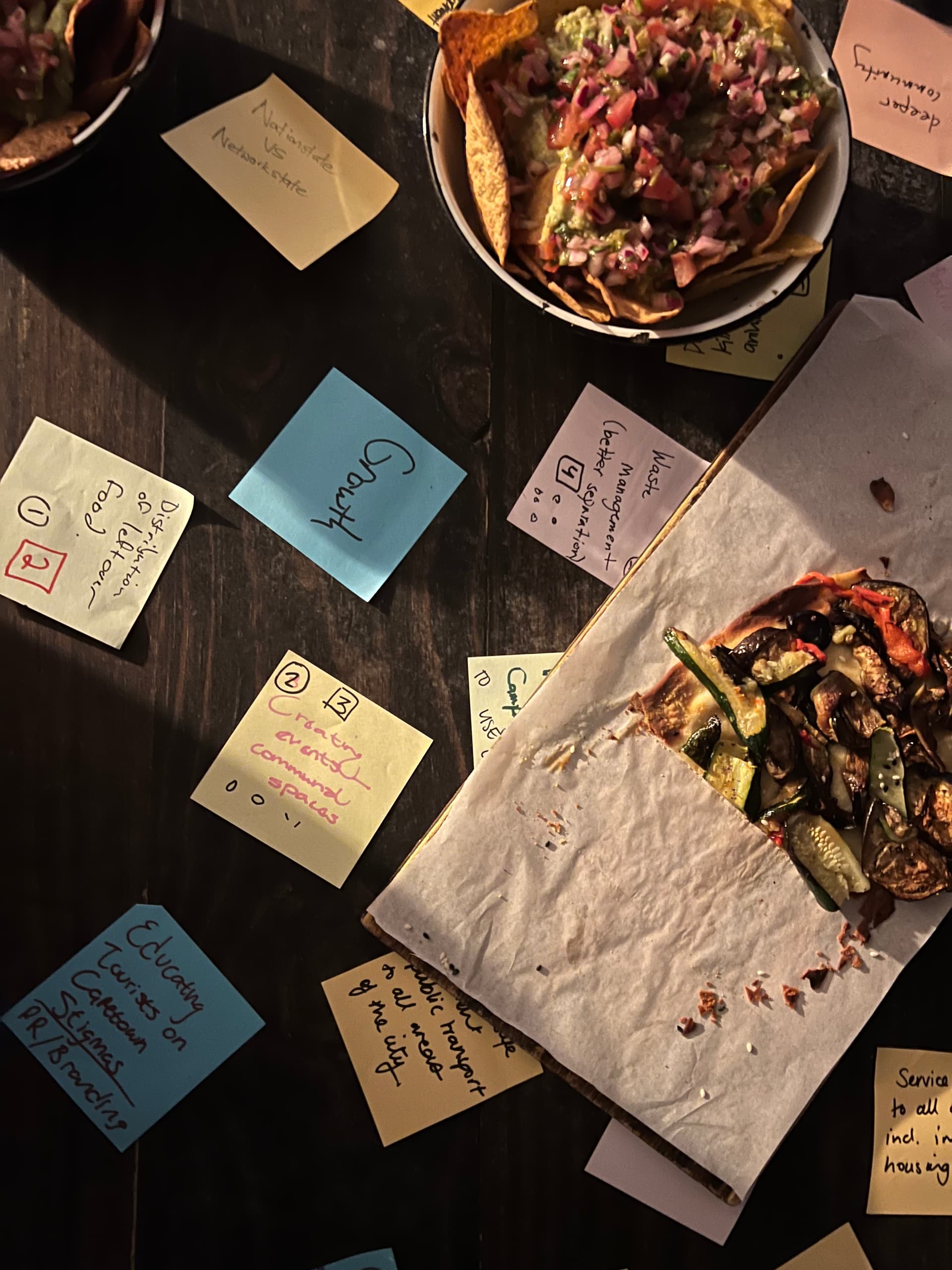
Logos Circle Cape Town — April 2026
Second gathering · report
Date: 22 April 2026
Location: The Electric, District Six, Cape Town
Registered on Luma: 20
Attended: 7 · roughly half return attendees from the first gathering, half new faces
Languages: English
Participants
- Attendance: 7 people attended, all based in Cape Town, South Africa.
- Return rate: Roughly 50% return attendees from the first gathering, 50% new faces. The group was smaller than the first gathering, and deliberately so (see Context below).
- Backgrounds and areas of interest: The group brought a mix of community activism, creative and civic backgrounds — including a film-maker, a bookseller and community activist, an estate agent, and a Master’s student in anthropology — alongside a technical thread via a software engineer and a participant working in web3 public goods who also stewards a sister network in Cape Town. Shared interests across the room included local social change, food systems and food security, community organising, parallel governance and its limits, the role of technology as a support to community action, and Global South framings within decentralised movements.
Context
Promotion of the second gathering was deliberately lighter than the first. Fewer Luma blasts were sent, and the multi-platform push across Facebook groups, WhatsApp, LinkedIn and Telegram was scaled back. This was partly a function of steward capacity, and partly an experiment: who shows up when you stop pushing?
The answer is useful: a smaller, more self-selecting, more committed group. Nobody in the room needed to be persuaded to return; the live question was whether they wanted to take on a role.
Topics Discussed
1. Openings and motivations
Key points & insights
- After initial mingling, each participant shared what brings them into the space.
- Consistent thread: disillusionment with existing structures, paired with an active desire to contribute to local positive change.
- The room was looking for a space to do rather than only diagnose.
Action items / next steps
- None directly — this set the tone for the rest of the gathering.
2. Logos, parallel societies and the Circles concept
Key points & insights
- Introduced Logos, the idea of parallel societies as an alternative to reforming nation-state institutions, and Circles as the practical entry point.
- Emphasised starting small with winnable issues that are actually achievable.
- Open question: The “parallel governance” and “network state” framing sits in tension with Cape Town’s service delivery realities and postcolonial context. This tension was named in the room rather than smoothed over.
Technologies or tools mentioned
- The Logos stack was referenced at a high level (Blockchain, Messaging, Storage) but the conversation deliberately did not lead with tech (see Topic 3).
Action items / next steps
- Continue surfacing the Global South / postcolonial framing as a strategic contribution back to the wider Logos network.
3. Technology as support, not lead
Key points & insights
- Strong views in the room that technology should sit in support of issues on the ground.
- Conversations about Circles should not lead with tech — they should lead with community need.
- This echoed a through-line from the first gathering and hardened further here.
Action items / next steps
- Hold community-first framing as the Cape Town Circle’s working principle. Bring in the Logos stack where it is genuinely useful to a defined community need, not as an entry point.
4. Global South context and anthropological lens
Key points & insights
- One participant, a Master’s student in anthropology, brought a clear and sustained anthropological lens to the conversation.
- The group discussed the importance of being alert to Global South context and need, rather than absorbing direction uncritically from Global North framings.
- This is a positioning about how the Cape Town Circle understands its own role within Logos — not a rejection of the broader project.
Action items / next steps
- Carry this lens into the scoping of the winnable issue (see below), and into how the Cape Town Circle communicates back to the wider Logos network.
5. Scoping the winnable issue
Key points & insights
- Initial tendency in the room: reach for very large problems — poverty, crime, structural inequality.
- These were scaled back deliberately, on the principle that a winnable issue needs to be small enough to actually be won by a small group, while still mattering.
- The conversation converged on food — food waste, food distribution, food security — as the most promising direction.
- Threads raised inside this theme: restaurant-level food surplus, liability questions around redistribution, dignity in how distribution is handled, and the risk of duplicating work already being done.
- Existing organisations named: Gift of the Givers came up as a reference point and an example of the “no need to reinvent the wheel” principle.
Other issues raised (not taken forward this round)
- Gangsterism.
- Destigmatising drug use.
- A potential contact in Khayelitsha — held as a future connection.
Action items / next steps
- Define a specific, well-scoped winnable issue within the food theme at the next gathering.
- Between now and then: map existing organisations working on food waste, distribution and security in Cape Town, so the Circle’s contribution is additive rather than duplicative.
6. Roles and commitment
Key points & insights
- Clear commitment in the room to meeting monthly going forward.
- The group worked through what the Community Lead role actually involves and arrived at a clearer definition. Initial framing treated it as an outreach role — a single representative reaching out to other communities, organisations and people of influence. The steward pushed back on this: outreach of that kind is naturally split across the people who already hold those personal contacts, and is better understood as an “internal contact” function distributed across the Circle rather than a single designated role. The Community Lead role, as defined by the group, is instead about caring for the Logos Circle Cape Town community itself — the existing attendees and membership, as well as potential attendees and the demographic the Circle wants to reach and invite — and maintaining the social glue that keeps the community strong and growing.
- One participant who had initially committed to the Community Lead role at the gathering reflected afterwards, on reading the Logos literature taken home from the meeting, that they had committed more than they could realistically take on at this stage and would like to step back from the formal role. They remain committed to attending and learning, and want to take time to understand the movement more deeply before taking on a defined role. This was handled openly and with care.
Action items / next steps
- Tech Lead: filled. Committed to the role and to regular attendance.
- Community Lead: open. The role is now more clearly defined (internal community stewardship rather than external outreach), which should make it easier for the right person to step in when they emerge.
- Support role: one attendee committed to showing up regularly across roles.
- Comms Lead and Impact Lead: open. To be revisited at the next gathering, alongside scoping of the winnable issue.
7. Feedback on Logos materials and framing
Key points & insights
- A participant flagged that having the Logos literature (zines, printed materials) on display as people arrive risks making the gathering feel cultish, niche, and less inviting — particularly to a diverse audience that the Circle is actively trying to reach.
- The suggestion was to keep the literature available but to one side, and to bring it out only when relevant or specifically asked after, rather than presenting it as a foregrounded part of the room.
- The same participant also noted, after taking the materials home and reading them more thoroughly, that the literature itself sets a high bar of commitment and conceptual familiarity — useful feedback on how the materials land with newcomers who are drawn in by the community work but are still orienting to the broader Logos movement.
Action items / next steps
- Adopt the “literature available but not on display” approach for the next gathering as a default.
- Flag this feedback to the wider Logos network as input on how onboarding materials are received by new attendees, particularly outside the existing Logos-fluent audience.
Winnable issues update
- Current status: No winnable issue formally defined yet. The group has converged on a theme — food (waste, distribution, security) — and will narrow this to a specific problem at the next gathering.
- Updates outside the meeting: None to report at this stage; the Circle is pre-scoping.
- Blockers:
- The natural pull towards issues too big to act on (poverty, crime) needs active steering at each gathering.
- Liability questions around food redistribution will need practical answers before the issue can be fully scoped — worth mapping early.
- Duplication risk: existing organisations are already active in this space. The Circle needs to identify where it can usefully add something rather than reinvent work already being done.
- Planned follow-up actions:
- Tech Lead: begin scoping what tech support, if any, a food-focused winnable issue might realistically call for — staying in “support not lead” mode.
- Community Lead (role open): the steward will hold the community-first and Global South framings as the group moves into scoping, and will help surface any community voices not yet in the room, until the role is filled.
- Support role: flexible support across roles as scoping gets underway.
- Steward (Muriel): map existing food-related organisations in Cape Town (Gift of the Givers and others) before the next gathering; prepare a short framing for the scoping conversation; follow up on the contact in Khayelitsha for future connection.
What we learned / to improve / new ideas
What worked well
- Lighter promotion produced a smaller, more committed, more self-selecting group. For a Circle at this stage, depth over breadth served the gathering well.
- Keeping the agenda unhurried allowed the room to push back on tech-first framing and steer the conversation towards community need — without that space, the pushback probably would not have surfaced.
- Naming the postcolonial and Global South tension directly, rather than routing around it, made the conversation more honest and pulled out an anthropological lens (held by one of the participants) as a genuine asset.
- Scaling back from overwhelming issues (poverty, crime) to a workable theme (food) happened inside the room, collectively — not imposed.
Areas for improvement
- The group is still at “theme” rather than “defined winnable issue”. Next gathering needs a tighter scoping structure so the food theme turns into an actual, specific problem the Circle commits to.
- Comms and Impact lead roles remain unfilled. Worth being explicit at the next gathering about what these roles involve, so attendees can self-identify rather than guess.
- Who was not in the room matters as much as who was. A food-focused winnable issue will need voices from communities most affected by food insecurity — worth planning deliberately for this before scoping locks in.
- Steward capacity is a real constraint on promotion and follow-up between gatherings. The light-touch approach was a reasonable response to this, but it is a constraint worth naming.
- Be aware that an in-the-moment commitment to a role can feel different once a participant has had time to read the Logos literature and reflect on what the movement actually involves. The Circle should treat role-filling as a process rather than a single moment, leave space for people to step back without friction, and consider checking in a few days after a gathering before treating commitments as locked in.
New ideas or experiments to try next time
- Run the winnable-issue scoping against the Logos checklist (clarity & focus, emotional resonance, actionable & measurable, aligned with Logos values) explicitly, in the room.
- Before the next gathering, prepare a short map of existing food-related organisations in Cape Town so the scoping conversation starts with who is already doing what, not a blank page.
- Consider whether a site visit or invited guest from an existing food organisation would sharpen the scoping.
- Continue the light-touch promotion approach for the next gathering as a deliberate test of what rhythm this Circle wants to grow at, rather than defaulting back to a harder push.
- Try keeping printed Logos materials available but to one side rather than on display as people arrive, and bring them out only when relevant or asked after — to keep the gathering feeling open and inviting rather than ideologically loaded.